
Our Handmade Sustainable Papers
Gampi Paper
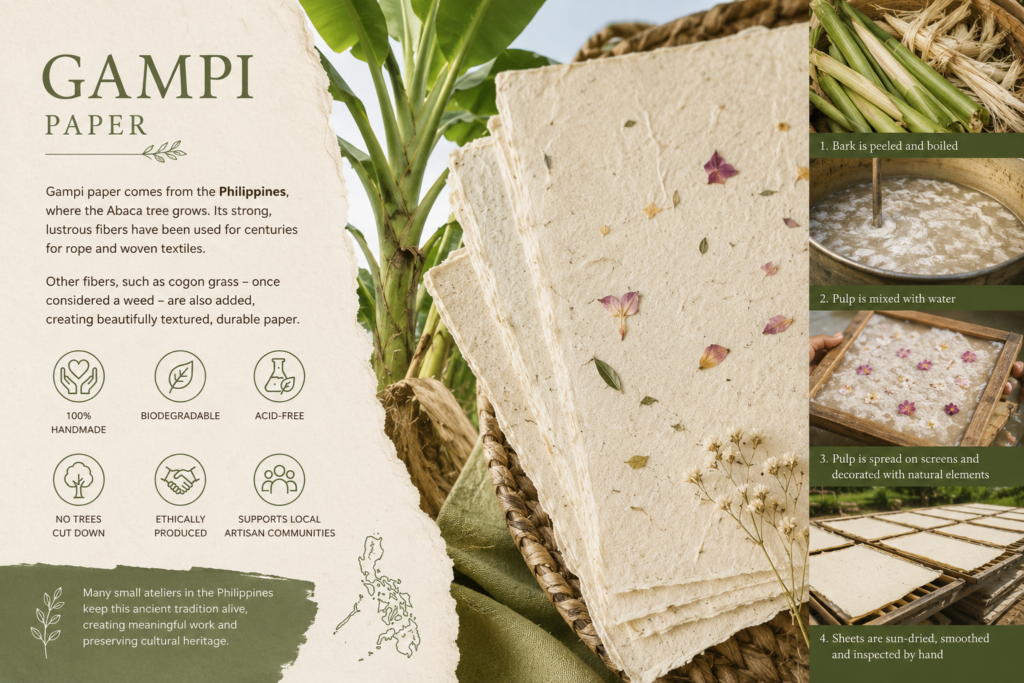
Gampi paper originates in the Philippines, where the Abaca tree grows. Although it closely resembles a banana tree, it is valued for its exceptionally strong fibres. For centuries, these fibres have been used to make ropes and woven textiles for clothing.
The Abaca tree produces long fibres with a beautiful natural sheen, making it ideal for papermaking. Other fibres are often added as well, including cogon grass, a wild grass that was once considered a weed until its suitability for papermaking was discovered.
- Production
After the bark is harvested, it is boiled in large vats and processed into pulp. The pulp is mixed with water and spread by hand across large screen frames. Decorative elements such as flower petals or dried leaves may be added during this stage.
The frames are then placed in the sun to dry. Once dry, the sheets are removed from the screens, smoothed, inspected, and prepared for dyeing, printing (including batik techniques), or further transformation into handcrafted products.
Many small workshops throughout the Philippines produce this paper, providing an important source of employment for local communities.
Mulberry Paper
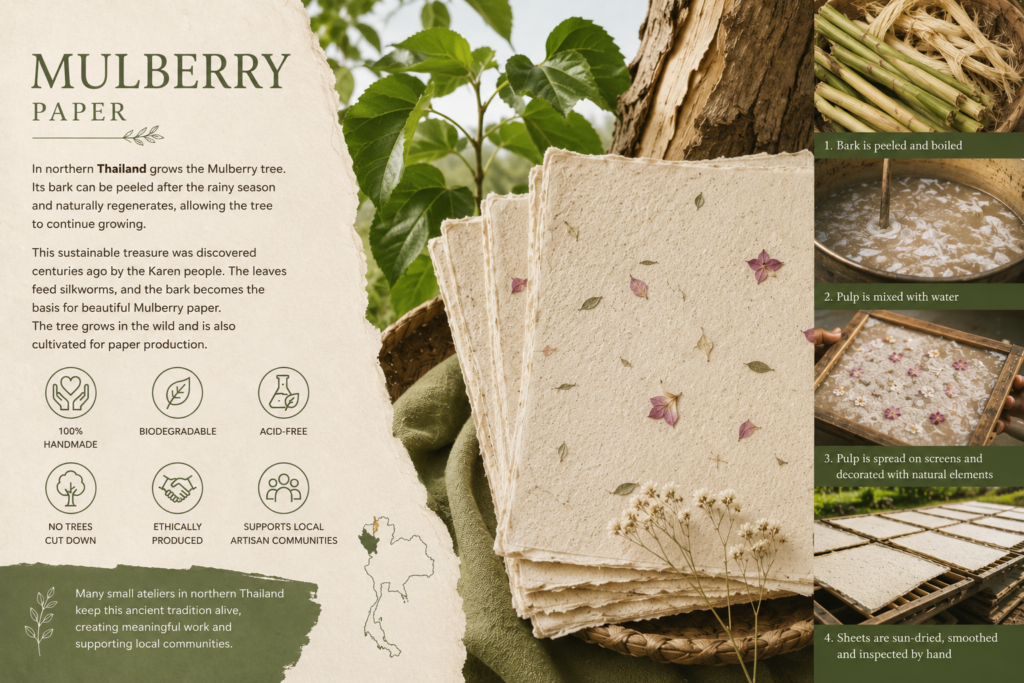
In northern Thailand grows a remarkable tree: the Mulberry tree. What makes it unique is that its bark can be carefully harvested after the rainy season and naturally regenerates, allowing the tree to continue growing.
This sustainable characteristic was discovered centuries ago by the Karen people, who live in the far north of Thailand. The leaves of the Mulberry tree provide food for silkworms, while its bark forms the basis of the beautiful Mulberry paper.
The tree grows naturally in the wild and is also cultivated specifically for paper production.
- Production
The harvested bark is boiled in large vats and processed into pulp. The pulp is mixed with water and applied by hand onto large screen frames. Decorative elements such as flower petals or dried leaves are often incorporated into the sheets.
The frames are left to dry naturally in the sun. Once the paper has dried, the sheets are removed from the screens, smoothed, inspected, and prepared for dyeing, printing (including batik techniques), or use in handcrafted products.
Many small workshops in northern Thailand produce this paper by hand, creating valuable employment opportunities and supporting local communities.
Lokta Paper
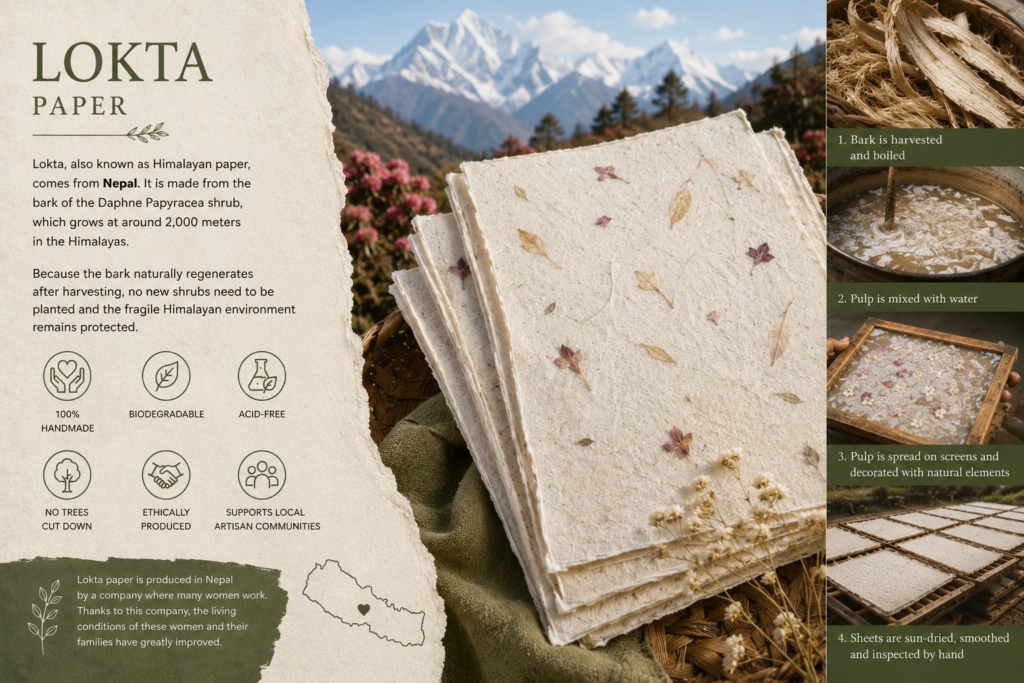
Lokta paper, also known as Himalayan paper, originates in Nepal. It is made from the bark of the Daphne papyracea shrub, which grows at elevations of around 2,000 metres in the Himalayas.
Because the bark naturally regenerates after harvesting, no new shrubs need to be planted and the fragile Himalayan environment remains protected. This makes Lokta paper one of the world’s most sustainable traditional papers.
- Production
Lokta paper is produced using an ancient and labour-intensive process that requires no chemicals. It possesses several remarkable qualities: exceptionally long and strong fibres that often surpass the durability of machine-made paper, a natural resistance to insects, and the ability to retain its strength for many years.
The long fibres also give the paper a subtle natural sheen. In addition, Lokta paper is highly suitable for dyeing and traditional batik techniques.
Much of the production supports local communities and provides meaningful employment opportunities for women and their families in Nepal. Because Nepal has no seaport, transportation costs for Lokta paper are relatively high.